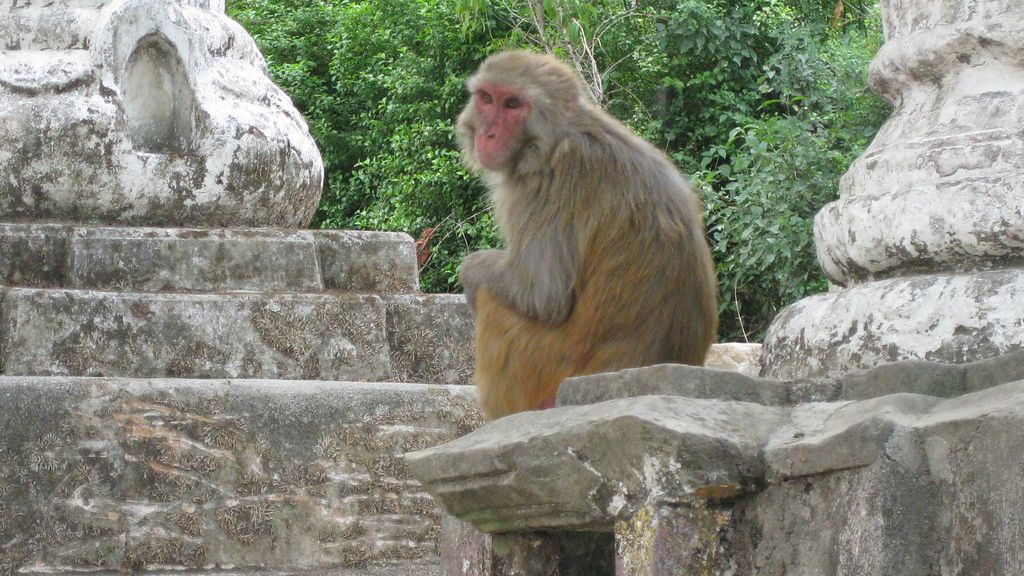
Last Saturday, I found myself climbing the familiar stone steps of Swayambhu, the ancient hilltop shrine that watches quietly over the Kathmandu Valley. For those of us who live in Kathmandu, it is more than a monument; it is a living space where devotion, tourism, chaos, and calm coexist in equal measure.
What makes Swayambhu especially fascinating is not only its spiritual aura, but its unusual social fabric. It is one of the rare places where monkeys and human beings share the same territory so intimately that they almost seem like parallel communities. On weekends, the temple complex is more crowded than usual. Devotees stand patiently in long queues to enter the shrine, carrying baskets filled with flowers, fruits, and sweets. The air is thick with incense, prayer chants, and anticipation.
The monkeys, meanwhile, are busy with their own affairs. Most of them are harmless observers. They groom one another, cradle their young, and leap across railings and stupas with effortless confidence. They do not disturb people without reason. Their world runs alongside ours, largely independent.
But in every species, there are the bold and the opportunistic.
Some monkeys have mastered the art of urban survival. While devotees wait in line, a quick, well-timed snatch is all it takes for a fruit or sweet to vanish from a basket. What struck me most was not the theft itself, but the pattern behind it. These monkeys have learned whom to target. They rarely confront tall, alert adults. Instead, they focus on children or shorter women who are least likely to react swiftly or resist effectively. Through daily coexistence with humans, they have understood vulnerability. They know where the reward is easiest.
As I walked down the steps, I could not help thinking how familiar that pattern felt.
Just the day before, during the colourful celebrations of Holi, a young woman was interviewed by a media outlet. Smiling and carefree, she shared why she was supporting a prominent political figure in the upcoming election. It was a simple, personal opinion and nothing more. Yet within hours, she became the subject of heavy online trolling.
Self-proclaimed intellectual influencers flooded social media with condescending commentary. They mocked her, questioned her intelligence, and generalized that young people in the country must have a “low IQ” if they held such views. The digital space turned into a battleground not of ideas, but of ego.
Watching this unfold, the image of those monkeys at Swayambhu returned to my mind.
We often pride ourselves on evolution – thousands of years of progress, education, civilization, and technology. Yet when it comes to disagreement, we sometimes behave no differently. We identify who is less powerful, less influential, less able to retaliate and we pounce. Not for survival, as animals might, but for validation, applause, and the illusion of superiority.
We have not fully evolved beyond the instinct to dominate the vulnerable. We have simply replaced fruits and sweets with likes, shares, and viral outrage.
There is a deeper issue at play. Many of us assume our opinions are the enlightened ones that will save the nation, while opposing views are signs of ignorance that will destroy it. This moral and intellectual arrogance widens divisions. It silences dialogue. It turns democracy into a contest of humiliation rather than a space for debate.
A free country must also be a free marketplace of ideas. Disagreement is natural; disrespect is not. No one deserves to be ridiculed simply for holding a different political belief. If we truly wish to elevate our society, the first step is not louder opinions. It is greater tolerance.
Standing at Swayambhu, observing the quiet intelligence of those monkeys, I wondered: perhaps evolution is not only biological. Perhaps it is moral. And perhaps we still have some distance to climb.