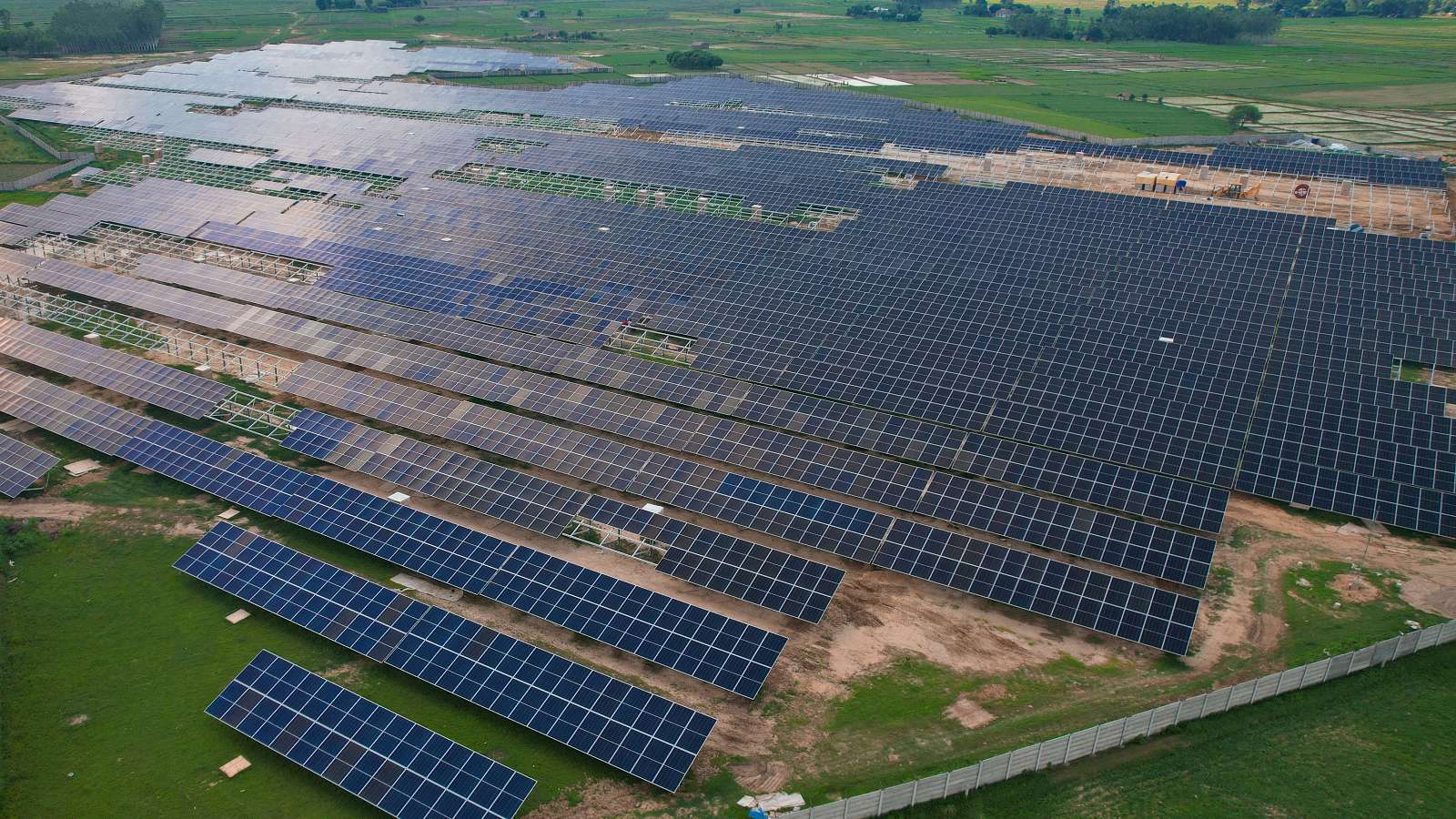
At first glance, a solar power plant seems almost simple: find a suitable piece of land, cover it with solar panels, and let the sun do the rest.
Of course, it is never quite that simple.
At Raniyapur in Khajura Rural Municipality, Banke, two solar power plants were developed side by side to form what became a 20 MW grid-connected solar project. When it came into operation, it was the largest solar PV plant in Nepal.
The project consists of two 10 MW AC blocks. Together, they have 38,444 bifacial solar modules spread across roughly 119,000 square metres. Under favourable solar conditions, the two blocks can generate about 40.5 GWh of electricity annually.
But the electricity generated by the panels is only the beginning of the story.
Two plants, one project
Although Block-1 and Block-2 sit next to each other and have identical AC capacities, they are not quite identical twins.
Block-1 uses 19,020 Canadian Solar bifacial modules mounted at a 19° tilt, while Block-2 uses 19,424 TrinaSolar modules at an 18° tilt. They also use different string inverter systems.
For someone looking at the site from a distance, this difference is hardly noticeable. From an engineering perspective, however, these are two separately configured 10 MW plants working together as one project.
And then there is the part that most people don’t see.
From a solar panel to the national grid
Generating electricity at the site is only half the job. The electricity has to leave the solar plant and find its way into the national grid.
For this project, that journey is 17 kilometres long.
A 33 kV double-circuit transmission line carries the combined output of the two solar blocks from Raniyapur to the Kohalpur Substation of the Nepal Electricity Authority.
So the journey of one unit of electricity is something like this:
Sunlight → Solar module → Inverter → Transformer → Transmission line → Kohalpur Substation → National Grid
What looks from a distance like a field of solar panels is therefore actually a much larger system of generation, conversion and transmission.
It took more than panels to build a power plant
The physical plant is perhaps the most visible part of the project, but it was preceded by years of agreements, approvals and preparation.
The project obtained its Grid Connection Agreement in Baisakh 2076, followed by Environmental Study Approval in Shrawan 2077 and the Generation Licence in Paush 2077.
The Power Purchase Agreement followed in Mangsir 2078, and the Credit Facility Agreement in Paush 2078.
Only after this long journey did the project reach the point where electricity could actually be generated and delivered to the grid.
Block-2 began commercial operation in Baisakh 2080, followed by Block-1 in Paush 2080.
There is something satisfying about looking at a completed solar plant and remembering that, before there were thousands of panels standing in neat rows, there were years of paperwork, planning, negotiations, engineering and construction behind it.
The numbers
20 – total AC capacity in MW
24 – total DC capacity in MW
38,444 – bifacial PV modules
40.5 – combined annual generation in GWh
17 – transmission line length in km
2 – 10 MW solar blocks
For me, however, the most interesting number isn’t necessarily the capacity.
It is the distance between the first idea and the moment when electricity actually started flowing.
That is what makes an infrastructure project interesting. A finished power plant may look permanent and inevitable when you see it today. But it was once only a proposal, followed by drawings, approvals, contracts, surveys, construction and a long list of problems that had to be solved along the way.
Eventually, all of that disappears into something deceptively simple:
sunlight becomes electricity, and electricity joins the grid.