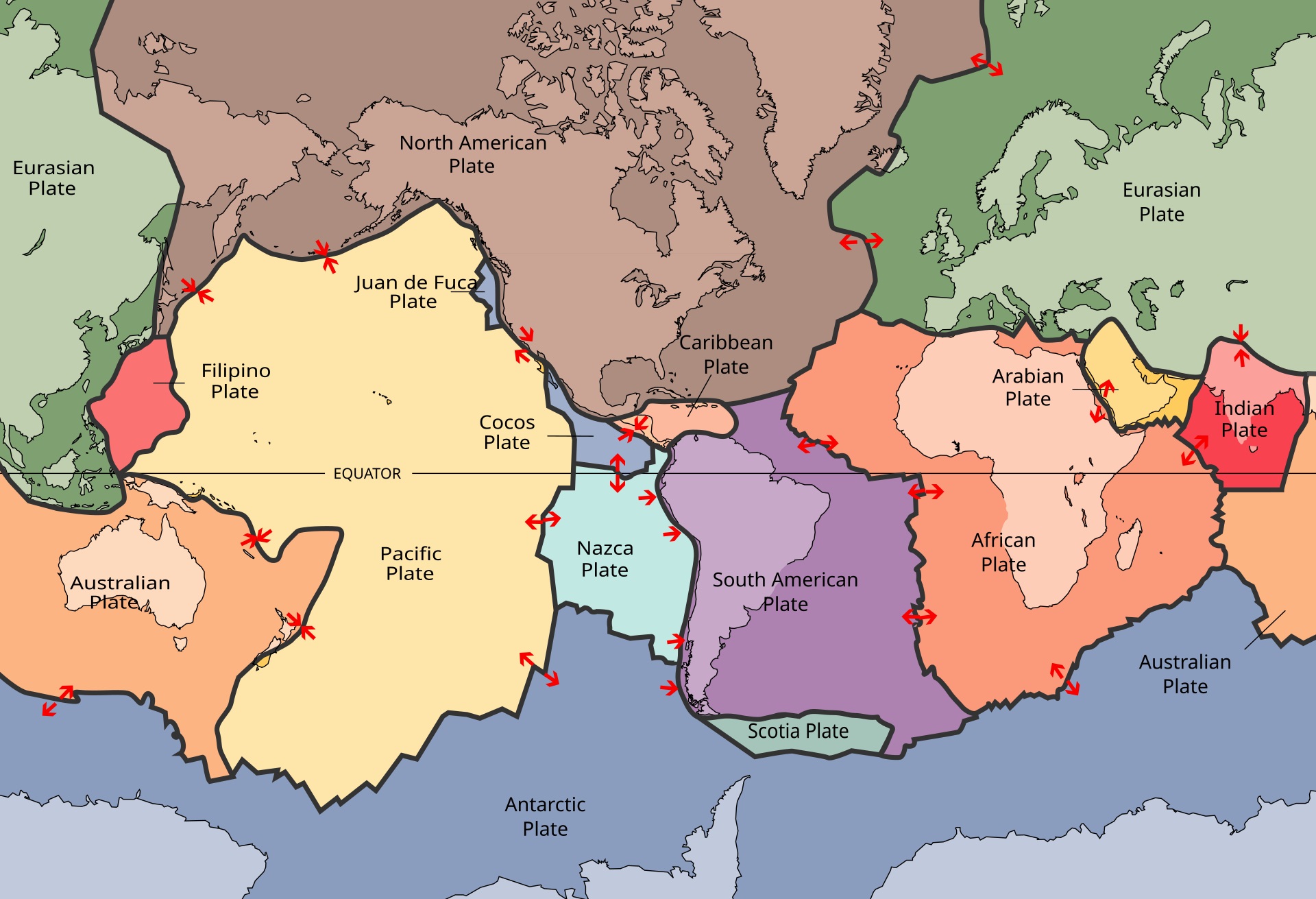
Imagine the Earth’s outer shell is like a cracked eggshell. The pieces of shell, called tectonic plates, are slowly moving, about as fast as your fingernails grow. When these pieces bump into, pull away from, or slide past each other, they cause earthquakes, volcanoes, and build mountains.
The theory says that Earth’s outer layer is not one solid piece. It’s broken into about 15-20 giant, rigid “plates” that float and drift on top of a hot, soft, gooey layer below.
Think of a chocolate milkshake that’s started to melt:
- The Lithosphere (The hard shell on top): This is the cracked eggshell. It’s made of the Earth’s crust (the ground we walk on) and the very top part of the mantle below. This is the plate itself.
- The Asthenosphere (The gooey layer underneath): This is hotter and under immense pressure, behaving like a very thick, slow-moving liquid (think hot tar or soft plastic). The rigid plates “float” and move on this gooey layer.
The movement happens because of convection, the same process we see in a pot of boiling soup.
- Hot stuff rises: Deep inside Earth, radioactive heat makes molten rock hot and less dense, so it slowly rises toward the surface.
- Cool stuff sinks: Near the surface, the rock cools, becomes denser, and slowly sinks back down.
- This creates a giant, slow-moving conveyor belt of gooey rock that drags the rigid plates along on top.
What Happens Where Plates Meet?
Almost all the action, earthquakes, volcanoes, mountains, happen at the edges where two plates interact. There are 3 main types of boundaries:
1. Divergent Boundaries (Moving Apart)
- What happens: Two plates pull away from each other. Hot magma rises from below to fill the gap.
- Creates: New ocean floor and underwater mountain ranges (ridges).
- Real-world example: The Mid-Atlantic Ridge (Iceland is being split apart by this).
- We might feel: Gentle volcanoes.
2. Convergent Boundaries (Moving Together)
This is where the big stuff happens. There are two sub-types:
A) Collision (Continent vs. Continent): Two plates carrying continents crash. Neither sinks because both are too light. They just crumple and pile up.
- Creates: The biggest mountain ranges.
- Real-world example: The Himalayas (India crashed into Asia).
B) Subduction (Ocean vs. Continent or Ocean vs. Ocean): One plate (usually the thinner, denser ocean plate) dives under the other plate and sinks into the mantle.
- Creates: Deep ocean trenches, volcanic mountain chains on the upper plate, and the strongest earthquakes.
- Real-world examples: The Andes Mountains (ocean plate diving under South America), the Ring of Fire around the Pacific Ocean.
3. Transform Boundaries (Sliding Past)
- What happens: Two plates scrape sideways past each other. They don’t create or destroy land, but they get stuck, build up pressure, then lurch free.
- Creates: Major earthquakes.
- Real-world example: The San Andreas Fault in California (the Pacific Plate slides past the North American Plate).
The Best “Aha!” Proof: Pangea
The evidence is so simple we can see it on a map: Look at a world map. Notice how the east coast of South America fits perfectly into the west coast of Africa? That’s not a coincidence.
- 300 million years ago, all the continents were joined into one supercontinent called Pangea.
- Then Pangea broke apart, and the pieces (plates carrying continents) slowly drifted to their current positions.
- We know this is true because we find identical fossils and same types of rocks on continents now separated by oceans (like a dinosaur fossil in both South America and Africa).
Why Should We Care?
Plate tectonics explains:
- Why Japan and California get so many earthquakes.
- Why the Pacific Rim is called the “Ring of Fire” (lots of volcanoes).
- How the Himalayas (Mount Everest) are still growing taller every year.
- Why fossils of the same ancient creature are found on opposite sides of the Atlantic Ocean.
- And most importantly, it’s the engine that shapes the entire surface of our planet over millions of years.
What was there before this theory?
Before plate tectonics, most geologists believed the Earth was cooling and contracting like a drying apple. This shrinking supposedly squeezed mountains upward. Oceans and continents were thought to be fixed in place; they did not move. The idea that continents had drifted (Continental Drift) was mocked for decades.
The Old, Rejected Correct Idea: Continental Drift (1912-1950s)
In 1912, a German meteorologist named Alfred Wegener proposed that all continents were once joined in a supercontinent called Pangea, then broke apart and drifted to their current positions.
His evidence was excellent (and later proved correct):
- The jigsaw fit of South America and Africa.
- Identical fossils on different continents (the reptile Mesosaurus in both South Africa and Brazil, but nowhere else).
- Matching mountain ranges and rock layers across oceans.
- Ancient coal deposits in Antarctica (proving it was once near the equator).
Why was he rejected?
He couldn’t explain how continents moved. He suggested they plowed through the ocean floor like ships through ice, but physicists said that was impossible, continents would crumble. Because he had no mechanism, his idea was dismissed as fantasy or “geopoetry.”
The Main Pre-Plate Tectonics Theory: Geosyncline Theory (1850s-1960s)
This was the standard, “textbook” explanation for mountains, volcanoes, and earthquakes. It assumed the Earth was fixed and cooling.
The core idea: The Earth started molten, then cooled and contracted, like a dried apple wrinkling. As the solid crust shrank, it buckled in places, creating mountains.
How it worked step-by-step:
- Geosynclines: A “geosyncline” was a giant, long, deep trough (depression) that slowly filled with layers of sediment (sand, mud, dead sea creatures) washed from nearby land. Think of it as a slowly sinking ditch that collects junk for millions of years.
- Thick Sediments: Over eons, this trough accumulated up to 10-15 km (6-10 miles) of sediment.
- Compression (The Squeeze): As the Earth continued to cool and shrink, horizontal pressure squeezed the sides of the geosyncline.
- Uplift (The Mountain): This squeeze folded, faulted, and pushed the massive pile of sediment upward, forming a mountain range (like the Appalachians or Alps).
The Major Problems With Geosyncline Theory (That Killed It)
By the 1950s, the old theory was falling apart because it couldn’t explain new discoveries:
- Where did all the sediment go? Rivers today don’t dump nearly enough sediment to fill those supposed ancient troughs.
- No shrinking evidence: Careful measurements showed Earth wasn’t shrinking enough to form mountains.
- Deep oceans were different: Mapping the ocean floor after WWII revealed mid-ocean ridges (a 65,000-km-long underwater mountain chain) and deep trenches. The old theory had no place for these.
- Seafloor was young: Dating ocean rocks showed they were less than 200 million years old (Earth is 4.5 billion years old). The ocean floor was constantly being renewed, not permanent.
The discovery that finally killed the old theories and birthed Plate Tectonics was seafloor spreading (Harry Hess, 1962).
- The key evidence: Magnetic stripes on the ocean floor. As lava erupts at mid-ocean ridges, it records Earth’s magnetic field. The stripes show the field flipping back and forth over time, symmetrically on both sides of the ridge.
- The conclusion: New ocean crust is constantly being created at ridges, spreading outward, and then sinking back into Earth at trenches. The continents are passengers on these moving plates.
Do Plate tectonics theory answer all the questions?
The short answer is: No, plate tectonics does not answer all questions. But it answers so many fundamental questions so well that it’s considered the unifying theory of geology, like the theory of evolution for biology or germ theory for medicine.
However, every good theory has limits and open questions. Here’s what plate tectonics explains brilliantly, what it struggles with, and what lies beyond it.
What Plate Tectonics Explains Brilliantly?
It answered the major puzzles that mystified scientists for centuries:
- Why earthquakes and volcanoes cluster in specific belts (like the Pacific Ring of Fire). → Plate boundaries.
- Why identical fossils and rocks appear on continents now separated by oceans. → Continents were once joined (Pangea) and drifted apart.
- Why the ocean floor is so much younger than the continents. → Seafloor is constantly created at ridges and destroyed at subduction zones.
- Why mountain ranges like the Himalayas are still rising. → Continents colliding.
- Why deep ocean trenches exist next to volcanic island chains. → Subduction of one plate beneath another.
In short, it provided a single, elegant mechanism that connected virtually all major geological observations.
What Plate Tectonics Does NOT Answer Well?
Here are the major questions where the theory falls short or is still debated:
1. What initially started plate tectonics on Earth?
We know how it works now, but how did it begin? Early Earth was hotter, the crust was different (possibly a single solid shell). What caused that first crack and subduction? This is an active area of research. Some think meteorite impacts or the weight of cooling crust kick-started it.
2. Why does Earth have plate tectonics, but Venus and Mars don’t?
Venus is similar in size to Earth but has a thick, stagnant lid; no moving plates. Mars has a single, thick, stationary crust. Why? The leading idea involves water: Earth’s surface water may act as a lubricant, softening rocks and allowing plates to slide. Venus lost its water; Mars never had enough. But this is not fully proven.
3. When exactly did plate tectonics begin?
Estimates range wildly, from 4.3 billion years ago (almost right after Earth formed) to just 700 million years ago (just before the Cambrian Explosion). The rock record from Earth’s early history (Hadean and Archean eons) is mostly destroyed or heavily altered, so we don’t know for sure. This is one of the hottest debates in geology today.
4. What drives plates in detail? (The finer mechanism)
We know convection in the mantle is the engine. But:
- Is the main force slab pull (the weight of a cold, dense subducting plate dragging the rest behind it) or ridge push (newly formed, hot rock at mid-ocean ridges pushing plates apart)?
- How do plumes of hot rock rising from deep within the mantle (mantle plumes, which cause hotspots like Hawaii) interact with plates?
- Why do some plate boundaries move, change, or die while others persist?
The broad strokes are clear, but the detailed physics is still being worked out.
5. Can plate tectonics explain all ancient mountain belts or rock formations?
Some very old mountain belts (like the Grenville Province in North America, ~1.1 billion years ago) don’t fit neatly into the simple collision or subduction models. They suggest that ancient plate tectonics might have worked differently (e.g., hotter, more frequent, or with different plate properties).
6. What happens below the plates? (Deep mantle mysteries)
Our understanding of plate tectonics is mostly about the upper 100-300 km (the lithosphere and asthenosphere). What happens when subducted plates sink all the way to the core-mantle boundary (~2,900 km deep)? We see massive “dense piles” of material there (called Large Low-Shear-Velocity Provinces, or LLSVPs), but we don’t fully understand their relationship to surface plates.
The Big “Beyond” Question: Is Plate Tectonics Unique to Earth?
We don’t know. We’ve only recently confirmed that Jupiter’s moon Europa has “plate-like” behavior on its icy shell. But that’s ice, not rock. For rocky planets, Earth is the only confirmed case. Finding evidence of past or present plate tectonics on another world (maybe ancient Venus or Mars) would be a major breakthrough.
The Bottom Line
Plate tectonics is the single most successful and important theory in Earth sciences. It answered a huge set of previously disconnected mysteries with one beautiful idea. But like all scientific theories, it is not a final truth, it’s our current best explanation with recognized limits and active frontiers.
Scientists today are not trying to overthrow plate tectonics. They are trying to:
- Refine it (better understanding of forces).
- Extend it (what happened in the deep past?).
- Test its limits (can it happen on other planets?).
The fact that it doesn’t answer every question isn’t a weakness, it’s an invitation to discover more. That’s how science works.